01 Painting of the Canals of Venice, Rudolf Ritter von Alt's Canal in Venice, with footnotes. #90

Rudolf Ritter von Alt, Austrian, 1812 - 1905
Canal in Venice, c. 1871
Watercolour over pencil on paper
27 by 37cm., 10½ by 14½in.
Private collection

Rudolf Ritter von Alt (28 August 1812 – 12 March 1905) was an Austrian landscape and architectural painter. Born as Rudolf Alt, he could call himself von Alt and held the title of a Ritter (knight) after he gained nobility in 1889.

Born in Vienna, he studied at the Akademie der bildenden Künste in Vienna. Hiking-trips through the Austrian Alps and northern Italy awoke a love for landscapes, and he painted with his brush using watercolors in a very realistic and detailed style. In 1833, inspired by a visit to Venice and neighbouring cities, he also made a number of architectural paintings.

Alt demonstrated a remarkable talent for expressing certain peculiarities in nature. He managed to paint nature authentically by focusing on the different hues of sky, the colour-tone of the air and the vegetation. His later works came closer to Impressionism. His perspectives on architecture were interesting, and he often chose everyday objects to paint. The painting of interior views also became one of his strong points, giving him attention in Vienna.

He visited and worked for a while in Rome and Naples; after that he visited the lakes of Lombardy, then Galicia, Bohemia, Dalmatia, Bavaria and then returned multiple times to Italy. In 1863 he went to the Crimea to paint some views of an estate of the Empress, and in 1867 he went to Sicily.

Alt died in Vienna in 1905. More on Rudolf Ritter von Alt


Please visit my other blogs: Art CollectorMythologyMarine ArtPortrait of a Lady, The OrientalistArt of the Nude and The Canals of VeniceMiddle East Artists365 Saints and 365 Days, also visit my Boards on Pinterest

Images are copyright of their respective owners, assignees or others. Some Images may be subject to copyright

I don't own any of these images - credit is always given when due unless it is unknown to me. if I post your images without your permission, please tell me.

I do not sell art, art prints, framed posters or reproductions. Ads are shown only to compensate the hosting expenses.

If you enjoyed this post, please share with friends and family.

Thank you for visiting my blog and also for liking its posts and pages.

Please note that the content of this post primarily consists of articles available from Wikipedia or other free sources online.

01 Painting of the Canals of Venice. Henry Martin Gasser's The Supply Boat , with footnotes. #89

Henry Martin Gasser, American, 1909-1981 
The Supply Boat 
Watercolor and gouache with traces of pencil on paper laid to board
12 3/4 x 17 inches
Private collection

Henry Martin Gasser, American (1909 - 1981) was born in Newark, New Jersey. He lived, studied and worked in New Jersey for his entire life. A Master at watercolor and oil his work consisted of, in his own words, "everyday subjects that are available to most of us-street scenes, back yards, trees, old houses, etc I looked for them in front of houses, in backyards, public parks, and elsewhere". He also painted numerous harbor and fishing village scenes. His Paintings contain a great deal of what he called "solitary silence" created by chosen subject matter such as a "Coming Storm", "Night in the Park", "Shadows"... He felt that Design was very important and meant the difference between a mediocre work and a truly professional one. It is here where Gasser excelled, his work demonstrates a sense of composition that gained wide spread appreciation for his work. 

He got his background in art studying at the Newark School of Fine and Industrial Art and the Grand Central School of Art. This was followed by study at the Art Students League of New York in the classes of Robert Bracman. He later studied privately under John R. Grabach. He is represented in over fifty museum collections and numerous important private ones as well. He served as Director of the Newark School of Fine and Industrial Art from 1946-54 then continued lecturing and demonstrating for most of the remainder of his life. He also wrote numerous books on painting. He died in Orange, NJ in 1981. More on Henry Martin Gasser


Please visit my other blogs: Art CollectorMythologyMarine ArtPortrait of a Lady, The OrientalistArt of the Nude and The Canals of VeniceMiddle East Artists365 Saints and 365 Days, also visit my Boards on Pinterest

Images are copyright of their respective owners, assignees or others. Some Images may be subject to copyright

I don't own any of these images - credit is always given when due unless it is unknown to me. if I post your images without your permission, please tell me.

I do not sell art, art prints, framed posters or reproductions. Ads are shown only to compensate the hosting expenses.

If you enjoyed this post, please share with friends and family.

Thank you for visiting my blog and also for liking its posts and pages.

Please note that the content of this post primarily consists of articles available from Wikipedia or other free sources online.

01 Painting of the Canals of Venice, Hercules Brabazon Brabazon's Zattere, Venice , with footnotes. #88

Hercules Brabazon Brabazon, (1821 - 1906)
Zattere, Venice 
Gouache and watercolour 
8.75 x 10.75in.
Private collection

The Zattere was built in 1519 and first used as a landing dock for the delivery of timber used to construct ships and buildings, which gave the quay the name Zattere, Italian for raft. 

The timber gone, the Zattere today is a spacious promenade that runs along the entire southern shore of Venice's Dorsoduro District, from the Marittima and San Basilio all the way to the Punta della Dogana. The island of Giudecca lies immediately to the south and a walk along the Zattere provides excellent Chiesa del Redentore, La Giudecca, Venice. More on The Zattere

Hercules Brabazon Brabazon (born Hercules Brabazon Sharpe; 27 November 1821 – 14 May 1906) was an English artist, accomplished in Turner-manner watercolours.

Brabazon was the younger son of Hercules Sharpe. Initially raised in Paris, he moved with his family to Oaklands, an estate near Sedlescombe, East Sussex, in 1832. He attended Harrow School, the École Privat, Geneva, and Trinity College, Cambridge, graduating with a B.A. in mathematics in 1844.

His father then wanted him to study law, but instead he left England and went to Rome to study music and art His father attempted to make him return by reducing his allowance, but in 1847, upon the death of his elder brother, he gained financial independence when he inherited family estates in Connaught, the will requiring that he change his surname to Brabazon. From then on he led a life of travel, art study and painting.

In 1858 he inherited Oaklands, whose management he left to his brother-in-law while he continued to travel - mostly in Europe, but with trips to Africa and India - always returning with his watercolours. Describing himself as living "for Art and Sunshine", he viewed himself as a gentleman amateur, and did not show or try to sell his work until his mid-seventies.

With the encouragement of artist friends, particularly John Singer Sargent, he began to exhibit, first at the New English Art Club, followed by successful one-man exhibitions at the Goupil Gallery in Bond Street. He died at Sedlescombe in 1906, and is buried there More on Hercules Brabazon Brabazon


Please visit my other blogs: Art CollectorMythologyMarine ArtPortrait of a Lady, The OrientalistArt of the Nude and The Canals of VeniceMiddle East Artists365 Saints and 365 Days, also visit my Boards on Pinterest

Images are copyright of their respective owners, assignees or others. Some Images may be subject to copyright

I don't own any of these images - credit is always given when due unless it is unknown to me. if I post your images without your permission, please tell me.

I do not sell art, art prints, framed posters or reproductions. Ads are shown only to compensate the hosting expenses.

If you enjoyed this post, please share with friends and family.

Thank you for visiting my blog and also for liking its posts and pages.

Please note that the content of this post primarily consists of articles available from Wikipedia or other free sources online.


02 Paintings of the Canals of Venice by John Bratby, with footnotes. #87

John Bratby R.A. (British, 1928-1992)
Lazy Back Canal and Arch and Gondola in Venice 
Oil on canvas
91.5 x 121.5cm (36 x 47 13/16in)
Private collection

John Randall Bratby, (born July 19, 1928, Wimbledon, Surrey.—died July 20, 1992, Hastings, East Sussex), was a British painter who rose to prominence in the 1950s as a member of the Kitchen Sink School, a group of British social-realist artists who paralleled the literary Angry Young Men of the decade.

Although he was accepted at the Slade School of Fine Art, Bratby attended the Royal College of Art (1951–54). His first solo exhibition, mounted at the Beaux Arts Gallery in London (1954), gained him instant popularity. For many years after his artwork appeared in the motion picture The Horse’s Mouth (1958), he was identified in the popular imagination with the film’s protagonist, a bohemian artist. Bratby was particularly known for the feverish speed at which he worked and for the thick texture of his vividly coloured, Expressionistic paintings, into which he often incorporated everyday objects. His productivity did not decline with his popularity in the 1960s, as he continued to create thousands of sketches and paintings, including hundreds of portraits. He wrote several autobiographical novels, notably Breakdown (1960), and served as editor in chief of Art Quarterly from 1987. More on John Randall Bratby

John Bratby R.A. (British, 1928-1992)
Gondola, Venice 
Oil on canvas
114 x 89cm (44 7/8 x 35 1/16in)
Private collection


Please visit my other blogs: Art CollectorMythologyMarine ArtPortrait of a Lady, The OrientalistArt of the Nude and The Canals of VeniceMiddle East Artists365 Saints and 365 Days, also visit my Boards on Pinterest

Images are copyright of their respective owners, assignees or others. Some Images may be subject to copyright

I don't own any of these images - credit is always given when due unless it is unknown to me. if I post your images without your permission, please tell me.

I do not sell art, art prints, framed posters or reproductions. Ads are shown only to compensate the hosting expenses.

If you enjoyed this post, please share with friends and family.

Thank you for visiting my blog and also for liking its posts and pages.

Please note that the content of this post primarily consists of articles available from Wikipedia or other free sources online.


01 Painting of the Canals of Venice, Epaminondas Thomopoulos' Venice, with footnotes. #86

Epaminondas Thomopoulos, (1878 - 1974)
Venice
Oil on hardboard
29.2 x 29.2 cm
Private collection

Epameinondas Thomopoulos (1878 - January 4, 1976) went as a boarder to school at the Institute of Kapodistrias in Corfu from 1892 to 1895. In 1896 he went to Naples where he studied at the Academy of Fine Arts until 1899. He continued his studies at the Academy of Fine Arts in Rome from 1899 to 1900. From 1901 to 1903 he studied at the Academy of Fine Arts in Venice. In 1915 he became Professor of the School of Fine Arts in Athens teaching until 1948 and in 1945 he was elected Director of the School. He died in Athens in 1976.

Most of his works and drawings are related with nature. Many of these are preserved in the Patras city hall and the National Gallery of Greece.

In 1996, the city of Patras awarded a large spot in the National Gallery of the city. More on Epameinondas Thomopoulos


Please visit my other blogs: Art CollectorMythologyMarine ArtPortrait of a Lady, The OrientalistArt of the Nude and The Canals of VeniceMiddle East Artists365 Saints and 365 Days, also visit my Boards on Pinterest

Images are copyright of their respective owners, assignees or others. Some Images may be subject to copyright

I don't own any of these images - credit is always given when due unless it is unknown to me. if I post your images without your permission, please tell me.

I do not sell art, art prints, framed posters or reproductions. Ads are shown only to compensate the hosting expenses.

If you enjoyed this post, please share with friends and family.

Thank you for visiting my blog and also for liking its posts and pages.

Please note that the content of this post primarily consists of articles available from Wikipedia or other free sources online.

01 Painting of the Canals of Venice, MARTÍN RICO Y ORTEGA, RIO DI SAN BARNABA, with footnotes. #85

MARTÍN RICO Y ORTEGA, Spanish, 1833 - 1908
RIO DI SAN BARNABA, VENICE
Oil on canvas 
26½ by 20¾ in., 67.3 by 52.7 cm
Private collection

A native of Spain, Martín Rico y Ortega was captivated by Venice and dedicated his oeuvre to recording its architecture, people and daily life. This work, set on the Rio di San Barnaba, features the Chiesa di San Barnaba in the foreground with Santa Maria dei Carmini beyond. More on this painting

The Chiesa di San Barnaba is a small Neoclassical-style church in the district of Dorsoduro in Venice. It is dedicated to the Apostle Saint Barnabas.

A church at the site was built in the ninth century, but destroyed by fire in 1105. Rebuilt in 1350, it was reconstructed in its present form in 1776 . The 11th-century campanile, detached from the main body of the church, has a pine-cone shaped spire from the 1300s.

A scene in the 1989 film Indiana Jones and the Last Crusade was shot in the Campo San Barnaba in front of the church, with the church's façade as an imaginary library. More on The Chiesa di San Barnaba

Martín Rico y Ortega (12 November 1833, El Escorial – 13 April 1908, Venice, Italy) was a Spanish painter of landscapes and cityscapes. Rico was one of the most important artists of the second half of the nineteenth century in his native country, and enjoyed wide international recognition.

Rico was born in Madrid and received his earliest formal training at the city’s Real Academia de Bellas Artes de San Fernando, where he studied under Jenaro Pérez Villaamil. In 1860, having been awarded a government-sponsored scholarship, Rico moved to Paris to continue his studies.

His landscapes depict the French and Swiss countryside in a fully accomplished Realist style. Toward the end of 1870, due to political and social unrest caused by the outbreak of the Franco-Prussian War, Rico decided to leave France and return to his native Spain.

Rico moved to the southern city of Granada, joining Fortuny and his wife Cecilia, as well as the painter Ricardo de Madrazo. The three artists worked closely during this period, with the styles of Rico and Fortuny overlapping so much that their watercolors—a specialty for both artists—were often confused for one another. It was during this time that, through Fortuny’s influence, Rico’s paintings began to reveal a newfound sense of luminosity and color. His time in Andalucía was, according to his memoirs, one of his happiest, and also one of his most artistically productive periods. More on Martín Rico y Ortega


Please visit my other blogs: Art CollectorMythologyMarine ArtPortrait of a Lady, The OrientalistArt of the Nude and The Canals of VeniceMiddle East Artists365 Saints and 365 Days, also visit my Boards on Pinterest

Images are copyright of their respective owners, assignees or others. Some Images may be subject to copyright

I don't own any of these images - credit is always given when due unless it is unknown to me. if I post your images without your permission, please tell me.

I do not sell art, art prints, framed posters or reproductions. Ads are shown only to compensate the hosting expenses.

If you enjoyed this post, please share with friends and family.

Thank you for visiting my blog and also for liking its posts and pages.

Please note that the content of this post primarily consists of articles available from Wikipedia or other free sources online.


01 Painting of the Canals of Venice by Giulio Turcato, with footnotes. #83

Giulio Turcato, (1912 - 1995)
Venice
Oil on canvas 
cm 37 x 47
Private collection

Giulio Turcato (16 March 1912 in Mantua – 22 January 1995 in Rome) was an Italian artist, belonging to both figurative and abstract expressionist currents.

Turcato left Mantua and attended the Venice Academy’s school of nude studies in the early 1930s before moving to Milan and finding work in the firm of the architect Giovanni Muzio in 1937. Pulmonary illness led to frequent stays in sanatoriums. Having taken up painting, he found stimuli in the Cubist art of Pablo Picasso. His long participation in the Venice Biennale began by invitation with the 23rd Esposizione Internazionale d’Arte della Città di Venezia in 1942. He then moved to Rome a few months later and joined the Resistance. A signatory of the manifesto of the Nuova Secessione Artistica Italiana in 1946, he was a founding member of the Marxist-leaning, abstract art group: Forma 1 in 1947, with Ugo Attardi, Pietro Consagra, Piero Dorazio, Mino Guerrini, Achille Perilli, Antonio Sanfilippo and Giulio Turcato. In 1948, he helped found the Fronte Nuovo delle Arti. His art is abstract with expressionist overtones. The decision of the Venice Biennale to devote a room exclusively to his work at the 29th Esposizione Internazionale d’Arte della Città di Venezia in 1958 contributed to his international renown. He took part in Documenta II the following year and joined the Continuità group in 1961. More on Giulio Turcato


Please visit my other blogs: Art CollectorMythologyMarine ArtPortrait of a Lady, The OrientalistArt of the Nude and The Canals of VeniceMiddle East Artists365 Saints and 365 Days, also visit my Boards on Pinterest

Images are copyright of their respective owners, assignees or others. Some Images may be subject to copyright

I don't own any of these images - credit is always given when due unless it is unknown to me. if I post your images without your permission, please tell me.

I do not sell art, art prints, framed posters or reproductions. Ads are shown only to compensate the hosting expenses.

If you enjoyed this post, please share with friends and family.

Thank you for visiting my blog and also for liking its posts and pages.

Please note that the content of this post primarily consists of articles available from Wikipedia or other free sources online.

01 Painting of the Canals of Venice by the artists of their time, with footnotes. #84

Rhonda Carleton Holmes Nicholls, American (1854-1930) 
Woman beside a canal, Venice
Oil on panel, 
17 x 14 inches
Private collection

Rhoda Holmes Nicholls (March 28, 1854 – September 7, 1930) was an English-American watercolor and oil painter, born in Coventry, England. She studied art in England and Italy, and her work was viewed and praised at the time by the queens of both countries. A body of work was created in South Africa by Nicholls of Port Elizabeth area's scenery, wildlife and architecture. She lived there on her brothers' 25,000-acre ostrich farm for one year.

Her watercolor paintings and illustrations were published in journals, and her oil paintings won awards in the United States and Europe. Nicholls was a successful artist, writer and art instructor. She was actively involved in many art organizations as a member and leader. More on Rhoda Holmes Nicholls


Please visit my other blogs: Art CollectorMythologyMarine ArtPortrait of a Lady, The OrientalistArt of the Nude and The Canals of VeniceMiddle East Artists365 Saints and 365 Days, also visit my Boards on Pinterest

Images are copyright of their respective owners, assignees or others. Some Images may be subject to copyright

I don't own any of these images - credit is always given when due unless it is unknown to me. if I post your images without your permission, please tell me.

I do not sell art, art prints, framed posters or reproductions. Ads are shown only to compensate the hosting expenses.

If you enjoyed this post, please share with friends and family.

Thank you for visiting my blog and also for liking its posts and pages.

Please note that the content of this post primarily consists of articles available from Wikipedia or other free sources online.

01 Painting of the Canals of Venice by the artists of their time, with footnotes. #82

Félix François Georges Philibert Ziem, (French, 1821-1911)
A canal in Venice 
Oil on panel
16 3/4 x 10 7/8in (42.5 x 27.7cm)
Private collection

Félix Ziem (February 26, 1821 – November 10, 1911) was a French painter in the style of the Barbizon School. He was born Félix-Francois Georges Philibert Ziem in Beaune in the Côte-d'Or département of the Burgundy région of France. His mother was a native of Burgundy who had married an immigrant. Originally, Ziem planned to be an architect and studied at the School of Architecture in Dijon, and for a time he worked as an architect. In 1839 he moved to Marseilles, where he received some informal instruction in painting from Adolphe Monticelli. Painting developed from a hobby into a career following a visit in 1841 to Italy, where he fell in love with the city of Venice, a place that would become the source for many of his works, and to which he returned annually until 1892. Apart from Venetian scenes, he also painted many still lifes, portraits, and landscapes from a variety of places including Constantinople, Martigues, Cagnes-sur-Mer and his native Burgundy. More on Félix Ziem


Please visit my other blogs: Art CollectorMythologyMarine ArtPortrait of a Lady, The OrientalistArt of the Nude and The Canals of VeniceMiddle East Artists365 Saints and 365 Days, also visit my Boards on Pinterest

Images are copyright of their respective owners, assignees or others. Some Images may be subject to copyright

I don't own any of these images - credit is always given when due unless it is unknown to me. if I post your images without your permission, please tell me.

I do not sell art, art prints, framed posters or reproductions. Ads are shown only to compensate the hosting expenses.

If you enjoyed this post, please share with friends and family.

Thank you for visiting my blog and also for liking its posts and pages.

Please note that the content of this post primarily consists of articles available from Wikipedia or other free sources online.

01 Painting of the Canals of Venice by the artists of their time, with footnotes. #81

Thomas Moran, (American, 1837-1926)
Venice, c. 1890
Oil on canvas
20 x 30 inches (50.8 x 76.2 cm)
Private collection

 Moran was especially fond of using Venice as a theme, particularly because its large areas of expressive sky and reflective water were well suited to his interest in creating luminous effects. He wove references to activities along the city's waterways into his compositions, along with buildings, pilings, boats and their reflections. It seems significant to note that this 1890 painting was executed immediately following the two visits he made to the site, in 1886 and 1889. More on this painting

Thomas Moran (February 12, 1837 – August 25, 1926) from Bolton, England was an American painter and printmaker of the Hudson River School in New York whose work often featured the Rocky Mountains. Moran and his family, wife Mary Nimmo Moran and daughter Ruth, took residence in New York where he obtained work as an artist. He was a younger brother of the noted marine artist Edward Moran, with whom he shared a studio. A talented illustrator and exquisite colorist, Thomas Moran was hired as an illustrator at Scribner's Monthly. During the late 1860s, he was appointed the chief illustrator for the magazine, a position that helped him launch his career as one of the premier painters of the American landscape, in particular, the American West.

Moran along with Albert Bierstadt, Thomas Hill, and William Keith are sometimes referred to as belonging to the Rocky Mountain School of landscape painters because of all of the Western landscapes made by this group. More on Thomas Moran


Please visit my other blogs: Art CollectorMythologyMarine ArtPortrait of a Lady, The OrientalistArt of the Nude and The Canals of VeniceMiddle East Artists365 Saints and 365 Days, also visit my Boards on Pinterest

Images are copyright of their respective owners, assignees or others. Some Images may be subject to copyright

I don't own any of these images - credit is always given when due unless it is unknown to me. if I post your images without your permission, please tell me.

I do not sell art, art prints, framed posters or reproductions. Ads are shown only to compensate the hosting expenses.

If you enjoyed this post, please share with friends and family.

Thank you for visiting my blog and also for liking its posts and pages.

Please note that the content of this post primarily consists of articles available from Wikipedia or other free sources online.
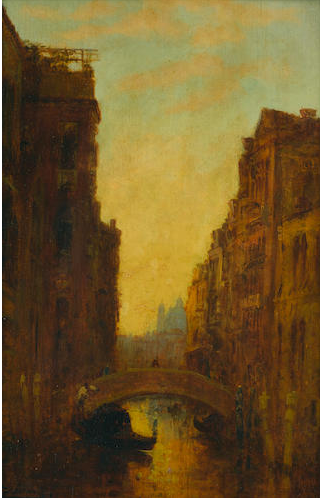

01 Painting of the Canals of Venice by the artists of their time, with foot notes. #79

Umberto Lilloni (Milan, 1898–1980)
Venice, c. 1946
Oil painting on canvas
40 x 30 cm
Private collection

Umberto Lilloni (Milan, 1898–1980) was an Italian painter.

Lilloni interrupted his studies at the Brera Academy of Fine Arts in 1917 when World War I broke out. Alternating landscape with figure painting in the 1920s, he received his first official recognition with the Prince Umberto Prize in 1927. His participation in the Venice Biennale began in 1928 with the 16th Esposizione Internazionale d’Arte della Città di Venezia. Involvement with the Novecento Italiano movement led to participation in their second group show in Milan in 1929. The influence of Chiarismo can also be seen in the gradual lightening of his palette. His first solo exhibition was held at the Galleria Bardi, Milan, in the same year. While the 1930s saw increased participation in exhibitions, including the Rome Quadrenniale and the Brera exhibitions at the national level, the art world showed less interest in his painting after World War II. More on Umberto Lilloni


Images are copyright of their respective owners, assignees or others. Some Images may be subject to copyright

I don't own any of these images - credit is always given when due unless it is unknown to me. if I post your images without your permission, please tell me.

I do not sell art, art prints, framed posters or reproductions. Ads are shown only to compensate the hosting expenses.

 If you enjoyed this post, please share with friends and family.

 Thank you for visiting my blog and also for liking its posts and pages.

 Please note that the content of this post primarily consists of articles available from Wikipedia or other free sources online.


A note to the readers of Zaidan Gallery

  A note to the readers of Zaidan Gallery It is with great sadness that we share the news that the author of this blog,  Henry Zaidan (194...