01 Painting of the Canals of Venice, Epaminondas Thomopoulos' Venice, with footnotes. #86

Epaminondas Thomopoulos, (1878 - 1974)
Venice
Oil on hardboard
29.2 x 29.2 cm
Private collection

Epameinondas Thomopoulos (1878 - January 4, 1976) went as a boarder to school at the Institute of Kapodistrias in Corfu from 1892 to 1895. In 1896 he went to Naples where he studied at the Academy of Fine Arts until 1899. He continued his studies at the Academy of Fine Arts in Rome from 1899 to 1900. From 1901 to 1903 he studied at the Academy of Fine Arts in Venice. In 1915 he became Professor of the School of Fine Arts in Athens teaching until 1948 and in 1945 he was elected Director of the School. He died in Athens in 1976.

Most of his works and drawings are related with nature. Many of these are preserved in the Patras city hall and the National Gallery of Greece.

In 1996, the city of Patras awarded a large spot in the National Gallery of the city. More on Epameinondas Thomopoulos


Please visit my other blogs: Art Collector, Mythology, Marine Art, Portrait of a Lady, The Orientalist, Art of the Nude and The Canals of Venice, Middle East Artists, 365 Saints and 365 Days, also visit my Boards on Pinterest

Images are copyright of their respective owners, assignees or others. Some Images may be subject to copyright

I don't own any of these images - credit is always given when due unless it is unknown to me. if I post your images without your permission, please tell me.

I do not sell art, art prints, framed posters or reproductions. Ads are shown only to compensate the hosting expenses.

If you enjoyed this post, please share with friends and family.

Thank you for visiting my blog and also for liking its posts and pages.

Please note that the content of this post primarily consists of articles available from Wikipedia or other free sources online.

01 Painting of the Canals of Venice, MARTÍN RICO Y ORTEGA, RIO DI SAN BARNABA, with footnotes. #85

MARTÍN RICO Y ORTEGA, Spanish, 1833 - 1908
RIO DI SAN BARNABA, VENICE
Oil on canvas 
26½ by 20¾ in., 67.3 by 52.7 cm
Private collection

A native of Spain, Martín Rico y Ortega was captivated by Venice and dedicated his oeuvre to recording its architecture, people and daily life. This work, set on the Rio di San Barnaba, features the Chiesa di San Barnaba in the foreground with Santa Maria dei Carmini beyond. More on this painting

The Chiesa di San Barnaba is a small Neoclassical-style church in the district of Dorsoduro in Venice. It is dedicated to the Apostle Saint Barnabas.

A church at the site was built in the ninth century, but destroyed by fire in 1105. Rebuilt in 1350, it was reconstructed in its present form in 1776 . The 11th-century campanile, detached from the main body of the church, has a pine-cone shaped spire from the 1300s.

A scene in the 1989 film Indiana Jones and the Last Crusade was shot in the Campo San Barnaba in front of the church, with the church's façade as an imaginary library. More on The Chiesa di San Barnaba

Martín Rico y Ortega (12 November 1833, El Escorial – 13 April 1908, Venice, Italy) was a Spanish painter of landscapes and cityscapes. Rico was one of the most important artists of the second half of the nineteenth century in his native country, and enjoyed wide international recognition.

Rico was born in Madrid and received his earliest formal training at the city’s Real Academia de Bellas Artes de San Fernando, where he studied under Jenaro Pérez Villaamil. In 1860, having been awarded a government-sponsored scholarship, Rico moved to Paris to continue his studies.

His landscapes depict the French and Swiss countryside in a fully accomplished Realist style. Toward the end of 1870, due to political and social unrest caused by the outbreak of the Franco-Prussian War, Rico decided to leave France and return to his native Spain.

Rico moved to the southern city of Granada, joining Fortuny and his wife Cecilia, as well as the painter Ricardo de Madrazo. The three artists worked closely during this period, with the styles of Rico and Fortuny overlapping so much that their watercolors—a specialty for both artists—were often confused for one another. It was during this time that, through Fortuny’s influence, Rico’s paintings began to reveal a newfound sense of luminosity and color. His time in Andalucía was, according to his memoirs, one of his happiest, and also one of his most artistically productive periods. More on Martín Rico y Ortega


Please visit my other blogs: Art Collector, Mythology, Marine Art, Portrait of a Lady, The Orientalist, Art of the Nude and The Canals of Venice, Middle East Artists, 365 Saints and 365 Days, also visit my Boards on Pinterest

Images are copyright of their respective owners, assignees or others. Some Images may be subject to copyright

I don't own any of these images - credit is always given when due unless it is unknown to me. if I post your images without your permission, please tell me.

I do not sell art, art prints, framed posters or reproductions. Ads are shown only to compensate the hosting expenses.

If you enjoyed this post, please share with friends and family.

Thank you for visiting my blog and also for liking its posts and pages.

Please note that the content of this post primarily consists of articles available from Wikipedia or other free sources online.


01 Painting of the Canals of Venice by Giulio Turcato, with footnotes. #83

Giulio Turcato, (1912 - 1995)
Venice
Oil on canvas 
cm 37 x 47
Private collection

Giulio Turcato (16 March 1912 in Mantua – 22 January 1995 in Rome) was an Italian artist, belonging to both figurative and abstract expressionist currents.

Turcato left Mantua and attended the Venice Academy’s school of nude studies in the early 1930s before moving to Milan and finding work in the firm of the architect Giovanni Muzio in 1937. Pulmonary illness led to frequent stays in sanatoriums. Having taken up painting, he found stimuli in the Cubist art of Pablo Picasso. His long participation in the Venice Biennale began by invitation with the 23rd Esposizione Internazionale d’Arte della Città di Venezia in 1942. He then moved to Rome a few months later and joined the Resistance. A signatory of the manifesto of the Nuova Secessione Artistica Italiana in 1946, he was a founding member of the Marxist-leaning, abstract art group: Forma 1 in 1947, with Ugo Attardi, Pietro Consagra, Piero Dorazio, Mino Guerrini, Achille Perilli, Antonio Sanfilippo and Giulio Turcato. In 1948, he helped found the Fronte Nuovo delle Arti. His art is abstract with expressionist overtones. The decision of the Venice Biennale to devote a room exclusively to his work at the 29th Esposizione Internazionale d’Arte della Città di Venezia in 1958 contributed to his international renown. He took part in Documenta II the following year and joined the Continuità group in 1961. More on Giulio Turcato


Please visit my other blogs: Art Collector, Mythology, Marine Art, Portrait of a Lady, The Orientalist, Art of the Nude and The Canals of Venice, Middle East Artists, 365 Saints and 365 Days, also visit my Boards on Pinterest

Images are copyright of their respective owners, assignees or others. Some Images may be subject to copyright

I don't own any of these images - credit is always given when due unless it is unknown to me. if I post your images without your permission, please tell me.

I do not sell art, art prints, framed posters or reproductions. Ads are shown only to compensate the hosting expenses.

If you enjoyed this post, please share with friends and family.

Thank you for visiting my blog and also for liking its posts and pages.

Please note that the content of this post primarily consists of articles available from Wikipedia or other free sources online.

01 Painting of the Canals of Venice by the artists of their time, with footnotes. #84

Rhonda Carleton Holmes Nicholls, American (1854-1930) 
Woman beside a canal, Venice
Oil on panel, 
17 x 14 inches
Private collection

Rhoda Holmes Nicholls (March 28, 1854 – September 7, 1930) was an English-American watercolor and oil painter, born in Coventry, England. She studied art in England and Italy, and her work was viewed and praised at the time by the queens of both countries. A body of work was created in South Africa by Nicholls of Port Elizabeth area's scenery, wildlife and architecture. She lived there on her brothers' 25,000-acre ostrich farm for one year.

Her watercolor paintings and illustrations were published in journals, and her oil paintings won awards in the United States and Europe. Nicholls was a successful artist, writer and art instructor. She was actively involved in many art organizations as a member and leader. More on Rhoda Holmes Nicholls


Please visit my other blogs: Art Collector, Mythology, Marine Art, Portrait of a Lady, The Orientalist, Art of the Nude and The Canals of Venice, Middle East Artists, 365 Saints and 365 Days, also visit my Boards on Pinterest

Images are copyright of their respective owners, assignees or others. Some Images may be subject to copyright

I don't own any of these images - credit is always given when due unless it is unknown to me. if I post your images without your permission, please tell me.

I do not sell art, art prints, framed posters or reproductions. Ads are shown only to compensate the hosting expenses.

If you enjoyed this post, please share with friends and family.

Thank you for visiting my blog and also for liking its posts and pages.

Please note that the content of this post primarily consists of articles available from Wikipedia or other free sources online.

01 Painting of the Canals of Venice by the artists of their time, with footnotes. #82

Félix François Georges Philibert Ziem, (French, 1821-1911)
A canal in Venice 
Oil on panel
16 3/4 x 10 7/8in (42.5 x 27.7cm)
Private collection

Félix Ziem (February 26, 1821 – November 10, 1911) was a French painter in the style of the Barbizon School. He was born Félix-Francois Georges Philibert Ziem in Beaune in the Côte-d'Or département of the Burgundy région of France. His mother was a native of Burgundy who had married an immigrant. Originally, Ziem planned to be an architect and studied at the School of Architecture in Dijon, and for a time he worked as an architect. In 1839 he moved to Marseilles, where he received some informal instruction in painting from Adolphe Monticelli. Painting developed from a hobby into a career following a visit in 1841 to Italy, where he fell in love with the city of Venice, a place that would become the source for many of his works, and to which he returned annually until 1892. Apart from Venetian scenes, he also painted many still lifes, portraits, and landscapes from a variety of places including Constantinople, Martigues, Cagnes-sur-Mer and his native Burgundy. More on Félix Ziem


Please visit my other blogs: Art Collector, Mythology, Marine Art, Portrait of a Lady, The Orientalist, Art of the Nude and The Canals of Venice, Middle East Artists, 365 Saints and 365 Days, also visit my Boards on Pinterest

Images are copyright of their respective owners, assignees or others. Some Images may be subject to copyright

I don't own any of these images - credit is always given when due unless it is unknown to me. if I post your images without your permission, please tell me.

I do not sell art, art prints, framed posters or reproductions. Ads are shown only to compensate the hosting expenses.

If you enjoyed this post, please share with friends and family.

Thank you for visiting my blog and also for liking its posts and pages.

Please note that the content of this post primarily consists of articles available from Wikipedia or other free sources online.

01 Painting of the Canals of Venice by the artists of their time, with footnotes. #81

Thomas Moran, (American, 1837-1926)
Venice, c. 1890
Oil on canvas
20 x 30 inches (50.8 x 76.2 cm)
Private collection

 Moran was especially fond of using Venice as a theme, particularly because its large areas of expressive sky and reflective water were well suited to his interest in creating luminous effects. He wove references to activities along the city's waterways into his compositions, along with buildings, pilings, boats and their reflections. It seems significant to note that this 1890 painting was executed immediately following the two visits he made to the site, in 1886 and 1889. More on this painting

Thomas Moran (February 12, 1837 – August 25, 1926) from Bolton, England was an American painter and printmaker of the Hudson River School in New York whose work often featured the Rocky Mountains. Moran and his family, wife Mary Nimmo Moran and daughter Ruth, took residence in New York where he obtained work as an artist. He was a younger brother of the noted marine artist Edward Moran, with whom he shared a studio. A talented illustrator and exquisite colorist, Thomas Moran was hired as an illustrator at Scribner's Monthly. During the late 1860s, he was appointed the chief illustrator for the magazine, a position that helped him launch his career as one of the premier painters of the American landscape, in particular, the American West.

Moran along with Albert Bierstadt, Thomas Hill, and William Keith are sometimes referred to as belonging to the Rocky Mountain School of landscape painters because of all of the Western landscapes made by this group. More on Thomas Moran


Please visit my other blogs: Art Collector, Mythology, Marine Art, Portrait of a Lady, The Orientalist, Art of the Nude and The Canals of Venice, Middle East Artists, 365 Saints and 365 Days, also visit my Boards on Pinterest

Images are copyright of their respective owners, assignees or others. Some Images may be subject to copyright

I don't own any of these images - credit is always given when due unless it is unknown to me. if I post your images without your permission, please tell me.

I do not sell art, art prints, framed posters or reproductions. Ads are shown only to compensate the hosting expenses.

If you enjoyed this post, please share with friends and family.

Thank you for visiting my blog and also for liking its posts and pages.

Please note that the content of this post primarily consists of articles available from Wikipedia or other free sources online.
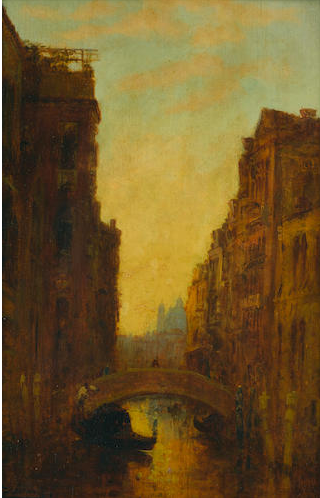

01 Painting of the Canals of Venice by the artists of their time, with foot notes. #79

Umberto Lilloni (Milan, 1898–1980)
Venice, c. 1946
Oil painting on canvas
40 x 30 cm
Private collection

Umberto Lilloni (Milan, 1898–1980) was an Italian painter.

Lilloni interrupted his studies at the Brera Academy of Fine Arts in 1917 when World War I broke out. Alternating landscape with figure painting in the 1920s, he received his first official recognition with the Prince Umberto Prize in 1927. His participation in the Venice Biennale began in 1928 with the 16th Esposizione Internazionale d’Arte della Città di Venezia. Involvement with the Novecento Italiano movement led to participation in their second group show in Milan in 1929. The influence of Chiarismo can also be seen in the gradual lightening of his palette. His first solo exhibition was held at the Galleria Bardi, Milan, in the same year. While the 1930s saw increased participation in exhibitions, including the Rome Quadrenniale and the Brera exhibitions at the national level, the art world showed less interest in his painting after World War II. More on Umberto Lilloni


Images are copyright of their respective owners, assignees or others. Some Images may be subject to copyright

I don't own any of these images - credit is always given when due unless it is unknown to me. if I post your images without your permission, please tell me.

I do not sell art, art prints, framed posters or reproductions. Ads are shown only to compensate the hosting expenses.

 If you enjoyed this post, please share with friends and family.

 Thank you for visiting my blog and also for liking its posts and pages.

 Please note that the content of this post primarily consists of articles available from Wikipedia or other free sources online.


01 Painting of the Canals of Venice, with footnotes. #80

Benjamin Chambers Brown, (1865-1942 Pasadena, CA) 
Venice
Oil on canvas 
18" H x 24" W
Private collection

Benjamin Chambers Brown (July 14, 1865 – January 19, 1942) was a California Impressionist landscape artist. He was one of their five children. He grew up in Little Rock, Arkansas. Brown was trained as a photographer. He studied at the University of Tennessee, and later at the St. Louis School of Fine Arts under Paul Harney and John Fry in 1884. He studied in Paris at the Académie Julian under Jean-Paul Laurens and Jean-Joseph Benjamin-Constant in 1890.

During his early career, Brown traveled and worked in St. Louis, Little Rock and Texas. In St. Louis, Brown taught at the St. Louis Art School. He went on to open his own school in Little Rock. He initially specialized in portraiture and still life. Upon moving to Pasadena in 1896, he began to paint landscapes. By 1905 he had become famous for his paintings. From 1909 to 1910, Brown had a studio in Mill Valley, California.

His first etchings were done in 1914. He co-founded the Print Makers of Los Angeles with his brother Howell in 1914, which later became the Los Angeles Society of Printmakers. His notable works include his impressionist landscapes of Sierra peaks and field poppies. 

Brown tried to sell his artwork in New York City; however, it did not sell as well as it had in California. Instead of opening a studio in the city, he began to sign California under his own signature to show how proud he was to be a Californian, in spite of potential stigmas. More Benjamin Chambers Brown


Images are copyright of their respective owners, assignees or others. Some Images may be subject to copyright
I don't own any of these images - credit is always given when due unless it is unknown to me. if I post your images without your permission, please tell me.
I do not sell art, art prints, framed posters or reproductions. Ads are shown only to compensate the hosting expenses.
 If you enjoyed this post, please share with friends and family.
 Thank you for visiting my blog and also for liking its posts and pages.

 Please note that the content of this post primarily consists of articles available from Wikipedia or other free sources online.

02 works on the Canals of Venice, with foot notes. #78

Thomas Moran, American, 1837-1926
Venice (The Splendor of Venice), c. 1899
Oil on canvas
20 x 30 1/8 inches
Private collection

Thomas Moran (February 12, 1837 – August 25, 1926) from Bolton, England was an American painter and printmaker of the Hudson River School in New York whose work often featured the Rocky Mountains. Moran and his family, wife Mary Nimmo Moran and daughter Ruth, took residence in New York where he obtained work as an artist. He was a younger brother of the noted marine artist Edward Moran, with whom he shared a studio. A talented illustrator and exquisite colorist, Thomas Moran was hired as an illustrator at Scribner's Monthly. During the late 1860s, he was appointed the chief illustrator for the magazine, a position that helped him launch his career as one of the premier painters of the American landscape, in particular, the American West.

Moran along with Albert Bierstadt, Thomas Hill, and William Keith are sometimes referred to as belonging to the Rocky Mountain School of landscape painters because of all of the Western landscapes made by this group. More on Thomas Moran


Images are copyright of their respective owners, assignees or others. Some Images may be subject to copyright

I don't own any of these images - credit is always given when due unless it is unknown to me. if I post your images without your permission, please tell me.

I do not sell art, art prints, framed posters or reproductions. Ads are shown only to compensate the hosting expenses.

If you enjoyed this post, please share with friends and family.

Thank you for visiting my blog and also for liking its posts and pages.


Please note that the content of this post primarily consists of articles available from Wikipedia or other free sources online.

01 Painting of the Canals of Venice, with foot notes. #77

Federico del Campo, (Peruvian, 1837-1927)
A View of The Scuola Grande di San Marco, Venice 
Watercolour
40 x 26cm (15 3/4 x 10 1/4in)
Private collection

The Scuola Grande di San Marco is a building in Venice. It was originally the home to one of the Scuole Grandi of Venice, or six major confraternities, but is now the city's hospital. It faces the Campo San Giovanni e Paolo, one of the largest squares in the city.

The edifice was built by the Confraternity of San Marco in 1260 to act as its seat. In 1485, however, it was destroyed by a large fire, and rebuilt in the following twenty years. While decorated with the polished marble elements of Renaissance classicism, the proliferation of arches and niches adds a retrogressive Byzantine flavor, an architectural feature of many conservative Venetian styles. One of the most notable aspects of the façade is the use of trompe-l'œil archways and portals on the ground floor, all executed in different types of marble.

Jacopo Tintoretto furnished the Scuola with three paintings Miracle of the Slave (also known as The Miracle of St. Mark, 1548), St Mark's Body Brought to Venice, painted between 1562 and 1566, both paintings are currently housed in the Gallerie dell'Accademia in Venice, and Finding of the body of St Mark also painted between 1562 and 1566, an now held in the Pinacoteca di Brera in Milan. More on The Scuola Grande di San Marco

Federico del Campo (1837-1923) was a Peruvian painter who was active in Venice where he was one of the leading vedute painters of the 19th century. Del Campo was born in Lima and left his native Peru at a young age. Nothing is known with certainty about his early studies in Peru. He studied at Madrid's Real Academia de Bellas Artes de San Fernando (Royal Academy of Fine Arts of San Fernando) in Madrid from around 1865. Here he established a friendship with Lorenzo Valles, a history painter. Del Campo subsequently travelled to Italy and painted in Naples, Capri, Rome, Assisi and Venice. During a visit to France he studied new artistic developments in Paris. From 1880, he exhibited works at the annual Salon van de Société des Artistes Français. In 1880 he established himself in Venice.

Here there already was a seizable community of emigré artists, such as Antonietta Brandeis, and the Spanish painters Martín Rico y Ortega, Mariano Fortuny and Rafael Senet. He became good friends with Martín Rico. The two artists worked sometimes together painting the Venetian scenes that were popular with the increasing number of visitors to that city. They responded thus to the large international market for their city views of Venice. Demand for del Campo's views was so strong, that he painted several views multiple times.

Particularly English tourists were taken by del Campo’s vedute of Venice. This was probably the reason why he moved to London in 1893 where he worked for a clientele of aristocrats and successful merchants. He was represented by art dealer Arthur Tooth who was able to organize a special exhibition of his work in Chicago during the World's Columbian Exposition of 1893. This success likely ensured del Campo’s comfortable life style. Little is known about his last two decades but it is likely that he died in London in 1923. More on Federico del Campo


Images are copyright of their respective owners, assignees or others. Some Images may be subject to copyright

I don't own any of these images - credit is always given when due unless it is unknown to me. if I post your images without your permission, please tell me.

I do not sell art, art prints, framed posters or reproductions. Ads are shown only to compensate the hosting expenses.

If you enjoyed this post, please share with friends and family.

Thank you for visiting my blog and also for liking its posts and pages.


Please note that the content of this post primarily consists of articles available from Wikipedia or other free sources online.

01 Painting of the Canals of Venice, with foot notes. #76

José García y Ramos, Spanish, 1852–1912
Bridge of Sighs
Oil on canvas
17 7/8 × 11 1/2 in, 45.4 × 29.2 cm
Private collection

The Bridge of Sighs is an enclosed bridge made of white limestone. It has windows with stone bars, passes over the Rio di Palazzo, and connects the New Prison to the interrogation rooms in the Doge's Palace. 

The view from the Bridge of Sighs was the last view of Venice that convicts saw before their imprisonment. The bridge's name, given by Lord Byron, comes from the suggestion that prisoners would sigh at their final view of beautiful Venice through the window before being taken down to their cells. In reality, the days of inquisitions and summary executions were over by the time the bridge was built. More on The Bridge of Sighs

José García Ramos ( Seville , 1852 - † Seville, April 2 , 1912 ), was a Spanish painter. Born in the city of Seville in the mid- nineteenth century. He was one of the main exponents of Andalusian costumbrista and regionalist painting of his time, and one of the best teachers of Seventh-century Seville school.

His artistic beginnings were developed between the cities of Seville and Rome, and are marked by his training in the workshop of José Jiménez Aranda and his dealings with Mariano Fortuny, whom he would meet in the Italian capital. A second stage of this artist is characterized by its luminous and colorful drawing, able to capture with skill the customs and human types of Seville where lived, sometimes for magazines such as Black and White. In his final stage, García Ramos shows his talent as a poster designer, with works made to announce events, such as the Spring Festival or some famous plays of the moment. 

Part of his work is in the Museum of Fine Arts of Seville, although most of his production is divided into private collections, since his work was very tasteful of the time and managed to sell a lot of pieces.

In the Sevillian museum there are about twenty paintings, of which, and for lack of space, only about a third is usually exposed to the public. More on José García Ramos 


Images are copyright of their respective owners, assignees or others. Some Images may be subject to copyright

I don't own any of these images - credit is always given when due unless it is unknown to me. if I post your images without your permission, please tell me.

I do not sell art, art prints, framed posters or reproductions. Ads are shown only to compensate the hosting expenses.

If you enjoyed this post, please share with friends and family.

Thank you for visiting my blog and also for liking its posts and pages.


Please note that the content of this post primarily consists of articles available from Wikipedia or other free sources online.

A note to the readers of Zaidan Gallery

  A note to the readers of Zaidan Gallery It is with great sadness that we share the news that the author of this blog,  Henry Zaidan (194...